Revora joins what you spent in Google and Meta to the jobs that were actually paid for in Stripe — so ROAS, CAC and cost per booked job are calculated on real revenue, by campaign, channel and location.
Live demo · sample account
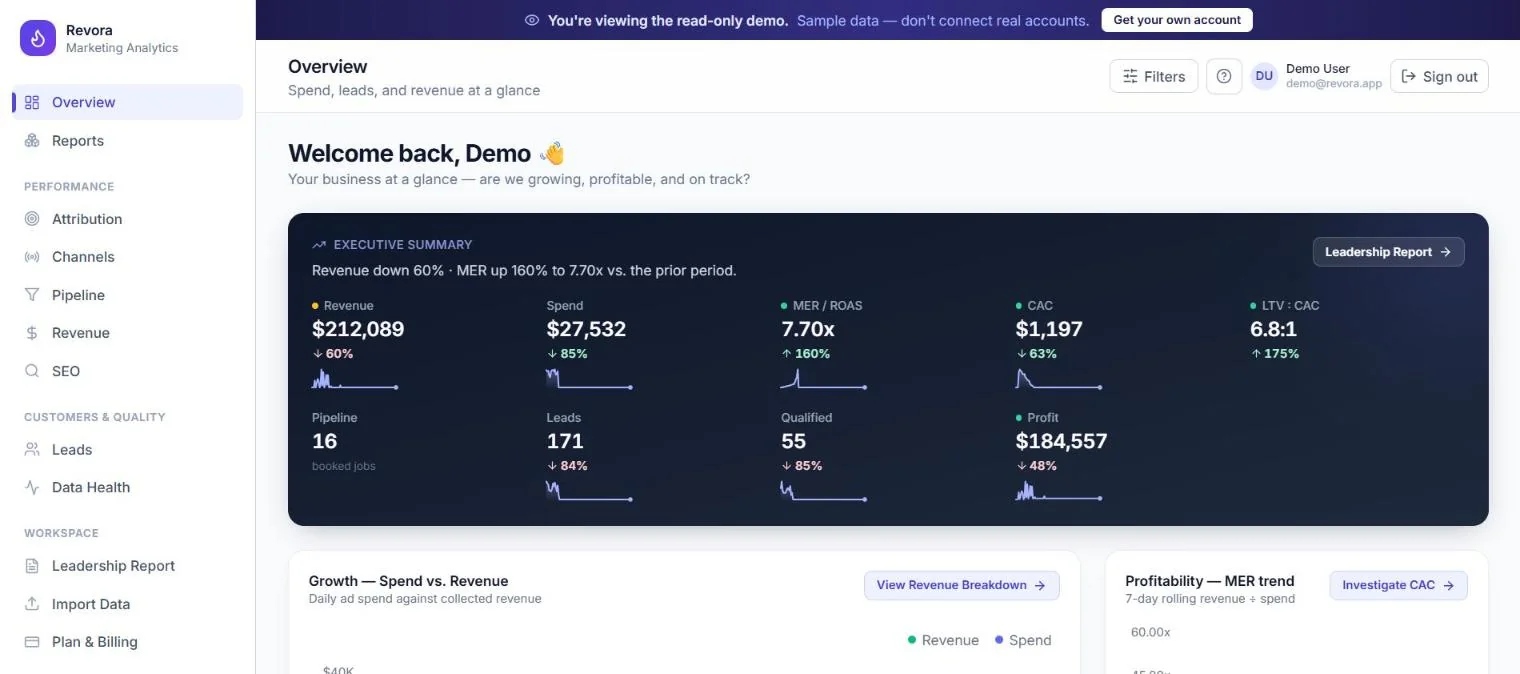
A marketing dashboard will happily show you impressions, clicks and cost per lead. None of that answers the only question the person paying actually has: which of this made us money? The spend lives in the ad platforms. The revenue lives in the CRM or the payment system. Nobody joins them, so budget decisions get made on the metrics that were easiest to measure rather than the ones that matter.
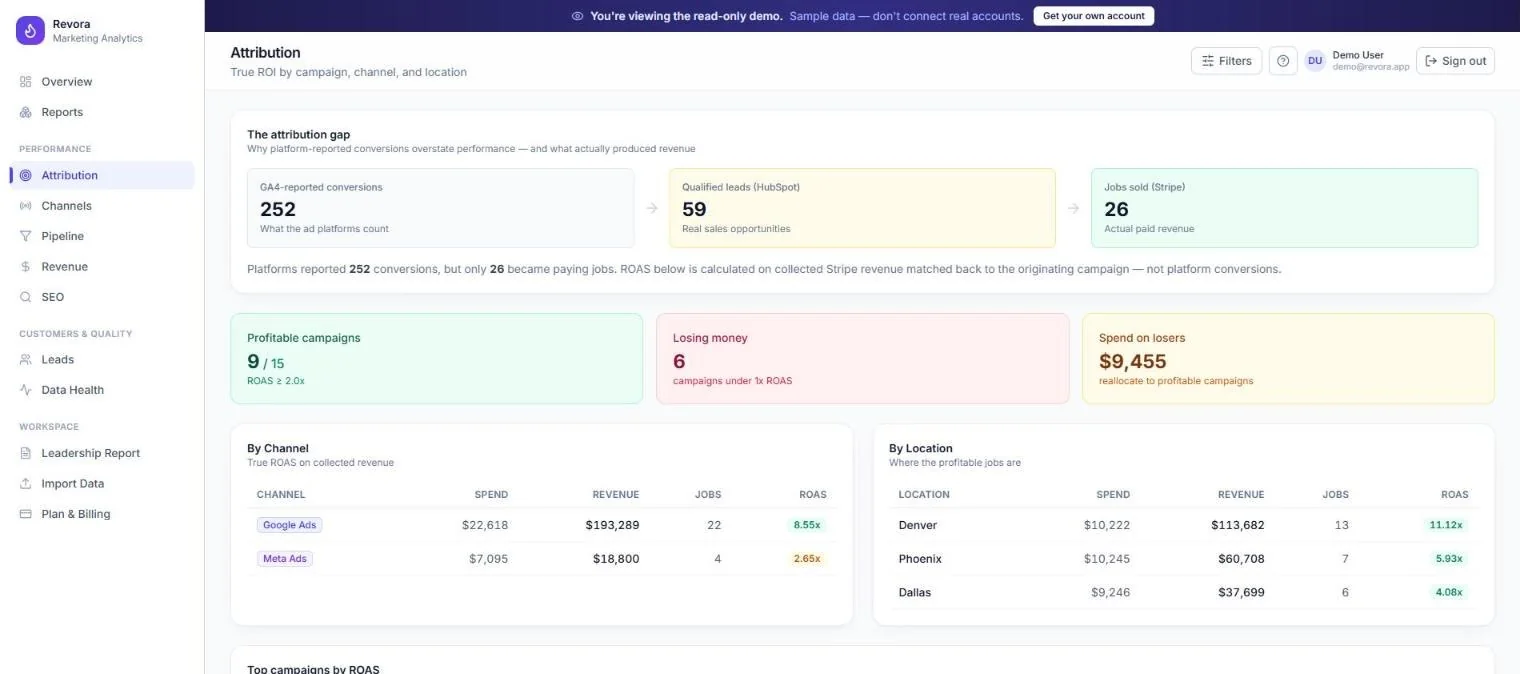
Ad platforms count conversions generously. Revora follows each one through the CRM to a payment, and calculates return on the money that actually arrived.
From the live demo · sample account · synthetic data, not a client result
Paste a read-only key for Stripe, HubSpot, GA4, Shopify or Search Console — or upload CSV exports from Google Ads and Meta Ads. No credentials handed over.
Each export is recognised and mapped automatically. Re-importing updates records in place instead of duplicating them.
Payments are matched to leads, and leads back to the campaign that produced them through their UTMs.
True ROAS and MER, CAC, LTV:CAC and cost per booked job — by channel, campaign and location, plus a one-page leadership report.
Real screens from the public demo account. Open it yourself — no sign-up.

The numbers an owner or investor asks for first — revenue, spend, MER, CAC, LTV:CAC and profit — each with its change against the prior period and a one-line summary of what moved.

The attribution gap, then what to do about it: profitable campaigns, campaigns losing money, and the spend on losers that could be moved — with true ROAS split by channel and by location.

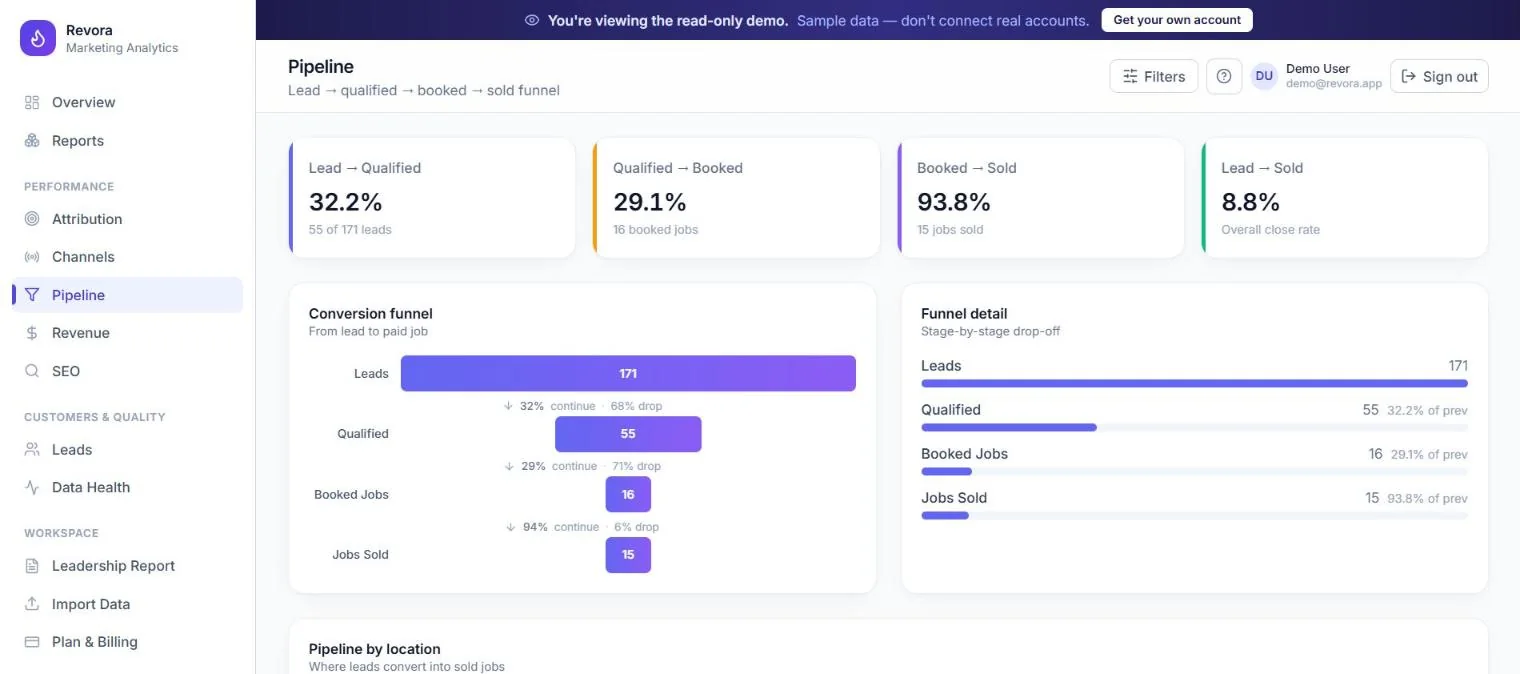
Lead → qualified → booked → sold, with the drop-off at every stage. Generic marketing tools stop at the lead; this is where a home-services business actually loses money.

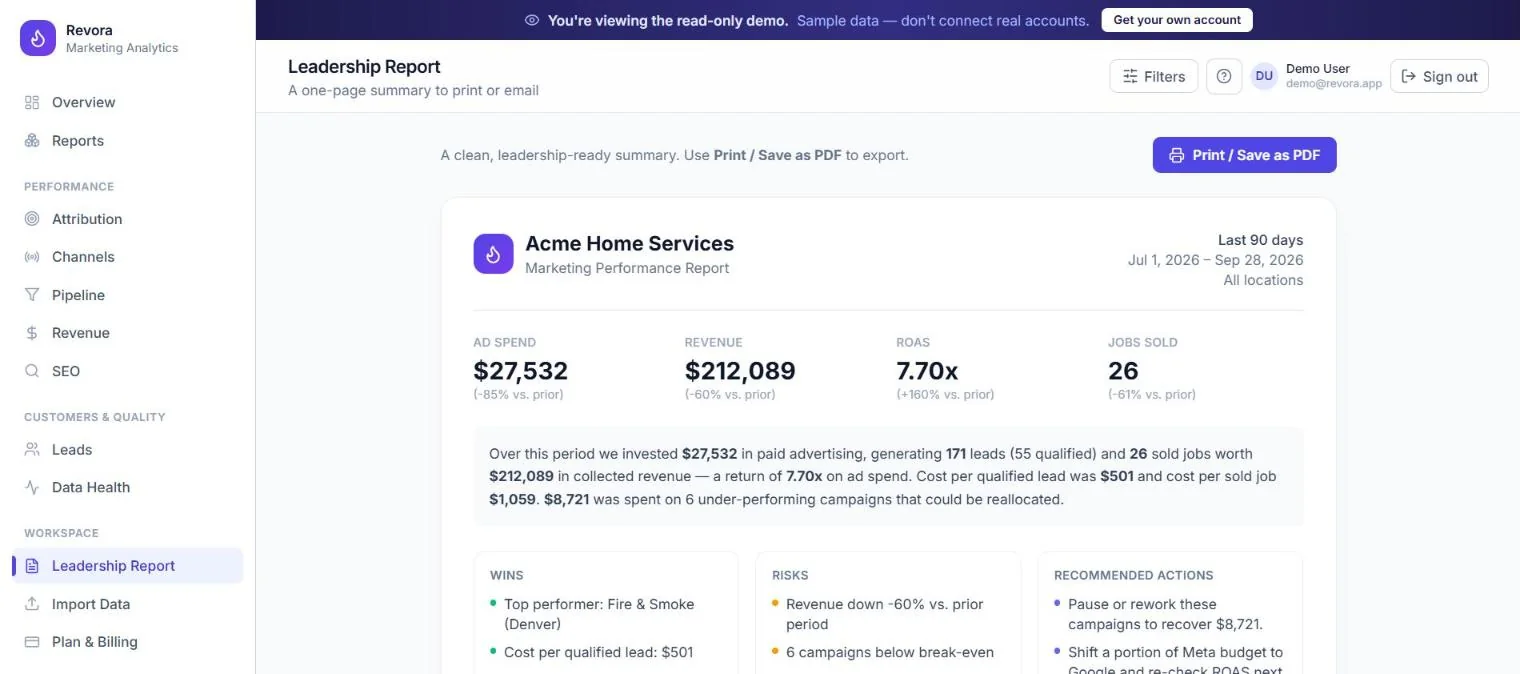
A one-page summary written in sentences, not charts: what was spent, what came back, wins, risks and recommended actions. Print it or save it as a PDF for the Monday meeting.

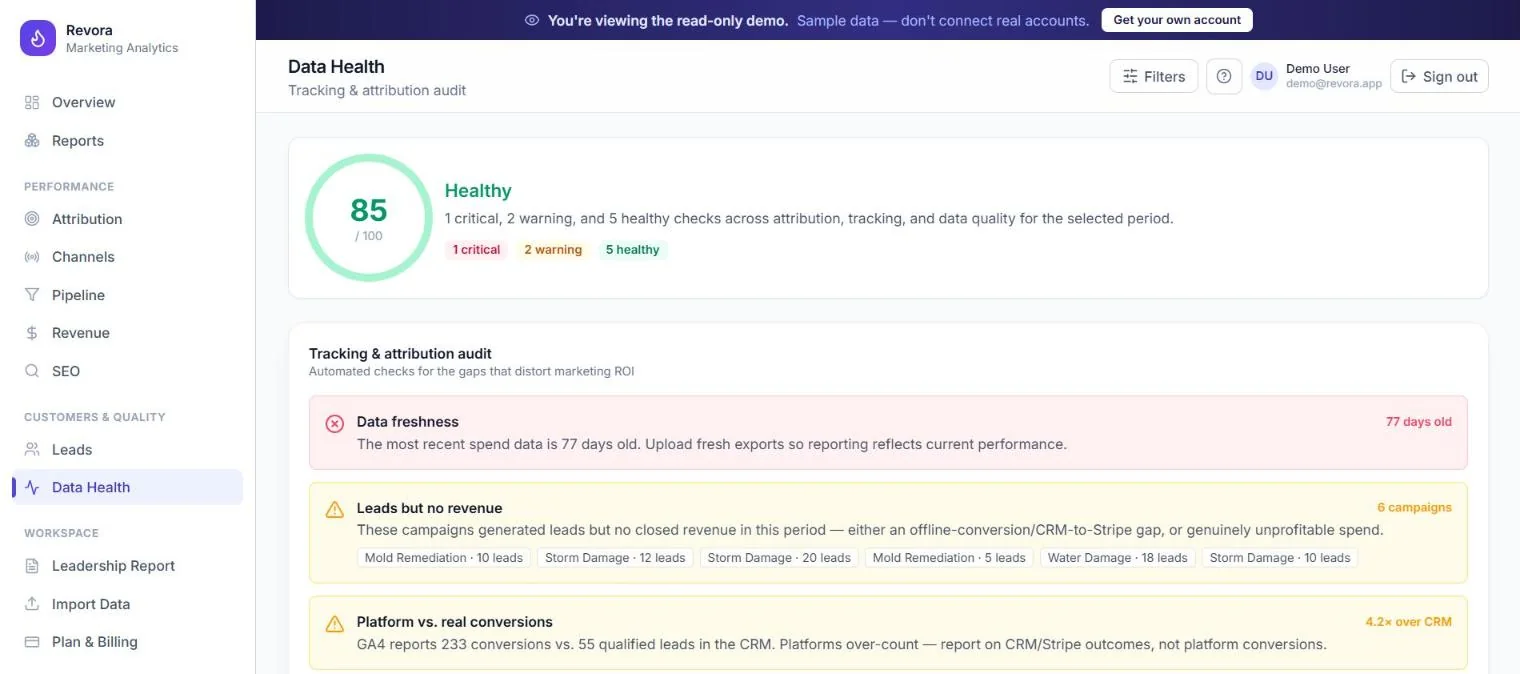
An automatic audit of the numbers themselves: stale data, campaigns with leads but no revenue, missing UTMs and platform over-counting — so a bad import never quietly becomes a bad decision.
Live demo · sample account · screens captured 28 Sep 2026 · all figures are synthetic
Return is calculated on payments that landed in Stripe, matched to the originating campaign — not on platform-reported conversions.
For businesses where a lead is not the finish line, the figure that matters is what a paid job costs to win. Revora reports it.
A channel that works in one city and loses money in another looks average in aggregate. Location is usually where the decision is hiding.
Lead, qualified, booked and sold, with conversion and drop-off at every step, and the same split by location.
A one-page, plain-English summary with wins, risks and recommended actions, ready to print or save as PDF.
A score out of 100 and automatic checks for stale data, untracked spend, missing UTMs and leads that never produced revenue.
Per-source CSV templates for Google Ads, GA4, Meta Ads, HubSpot and Stripe, mapped automatically and safe to re-import.
Organic search and paid campaigns in one view, so the whole demand picture is on one screen.
Your logo, name and colours, with branded client logins — each client sees their own brand and only their own data.
Revora is a Datavoris product: designed, built and run end to end — the data model, the ingestion and matching, the authentication and the interface on top. It is hosted as a shared multi-tenant SaaS.
Home-services owners — restoration, HVAC, roofing, plumbing — lead-generation businesses, and the agencies that run their marketing. Anyone for whom a lead has to become a paid job before it counts.
See it live ↗This is the same engineering a client engagement gets — the data model, the integrations, the authentication and the interface on top. Tell us what you are trying to build and we will tell you how we would approach it.