AI & Automation

The steps someone does by hand, done on a schedule

Every business has a person who copies things between systems on a Monday morning. We replace that job with something that runs on its own, logs what it did, and tells you when it cannot.
A workflow run log: runs today, success rate, average duration, and the last five runs with their triggers and statuses.
Success rate 100% 48 runs today, untouched

Sample data, fictional company

How it fits together

Four steps, and then nobody touches it

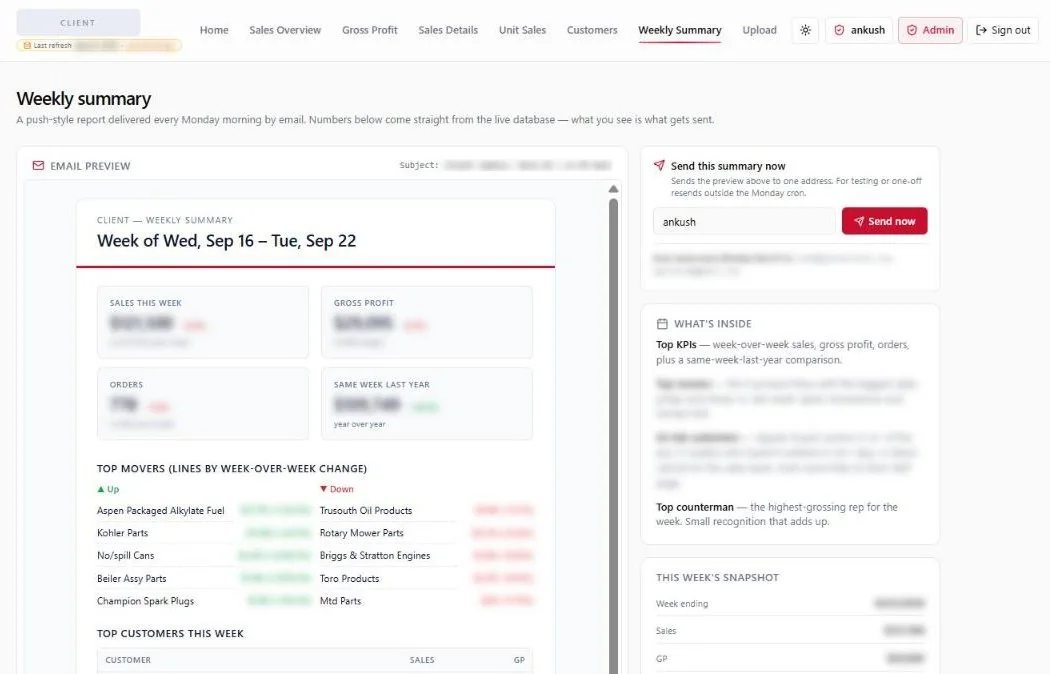
The work you are doing by hand every week is almost always this shape. Built once, it runs on a schedule and tells you when something breaks.

How an automated workflow runsA trigger starts the run; data is fetched and cleaned; rules or an AI step make the judgement call; results are delivered. The chain repeats on a schedule without anyone starting it.01TriggerA schedule, a new row,a form, a webhook02Fetch & cleanPull from everysystem, reconcile, validate03DecideRules, or an AI stepfor the judgement calls04DeliverWrite back, file, email,alert the right personRepeats on its own — errors alert you
The dashed line is the part that matters: it starts itself again, without anyone remembering to.
What we build

Three ways in

Pipelines Between Your Tools

The tools you already use, connected, so nothing waits on a human to move data between them.

  • Zapier, Make, Power Automate or pure Python — whatever fits
  • Runs on a schedule or on a trigger, hands-free
  • Error handling, retries and logging built in from the start
  • Alerts when something fails, so it never fails silently
ZapierPower AutomateMakePython

AI Workflow Automation

OpenAI and Claude wired into your actual data, for the jobs where a model genuinely beats a rule — and only those.

  • Summaries, classifications and drafted write-ups from real inputs
  • Document and report generation from raw source data
  • Wired into the tools your team already works in
  • Costed and rate-limited so the bill cannot surprise you
OpenAIClaude APIPythonFastAPI

Sheets & Excel Systems

The spreadsheet that runs a part of your business, turned into something that will not break when the person who built it is on leave.

  • Consolidation, validation and alerts that run themselves
  • Apps Script and VBA automation behind a familiar front end
  • Synced to a real database or dashboard underneath
  • Kept in a spreadsheet where a spreadsheet is genuinely the right answer
Apps ScriptAppSheetVBASheets
What it replaces

The before and the after

Every one of these is something a real client was doing by hand before we started.

How it works today
With a Datavoris portal
Someone spends Monday morning copying numbers between the CRM, the finance system and a sheet.
It happened at 6am, it logged what it did, and nobody opened a spreadsheet.
A report gets written by hand for every new client, from the same template, every time.
The intake form triggers it. A branded document lands in their inbox minutes later.
The spreadsheet that runs a department breaks whenever its author is away.
The logic is documented, automated and monitored. Being on leave stops being a risk.
Something we built

Automated Diagnostic Engine

A coaching business was hand-writing a diagnostic report for every new client. We wired the intake form to a Python pipeline that scores the answers, drafts the write-up with OpenAI and sends a branded PDF on its own. A twelve-hour report cycle became minutes, and more than 120 coaches run on it today.

Is this the one you need?

Describe what is happening today in a few lines. If a different family fits better, we will say so — and if it is not a fit at all, we will point you somewhere that is.