Every project ended the same way.
For eight years I built the dashboards and pipelines businesses quietly run on. It worked — and then they had to call me the moment their data changed. I started Datavoris to build the opposite: reporting a company updates itself.
Chapter 01
I started out building dashboards for other people’s companies. Eight years of it — Power BI reports, data models, and the pipelines a Monday morning meeting quietly depends on. First inside consulting and enterprise teams, then on my own, where I have stayed Top Rated Plus on Upwork across more than a hundred builds.
Consulting. Manufacturing. HR. Finance. Operations. Different industries, the same shape of problem every time.
Chapter 02
Every project ended the same way. It worked. The client was happy. And then a few weeks later they were back — not because anything had broken, but because the data had changed. A new month’s file. A renamed column. One more region.
Ten minutes of work that instead cost them a message to me, a quote, and three days of waiting.
Chapter 03
The dependency was not a flaw in what I had built. It was what I had built.
It took me far too long to see that clearly. Most data consultants are paid to remain necessary, and I had been quietly doing the same thing and calling it a service.
Chapter 04
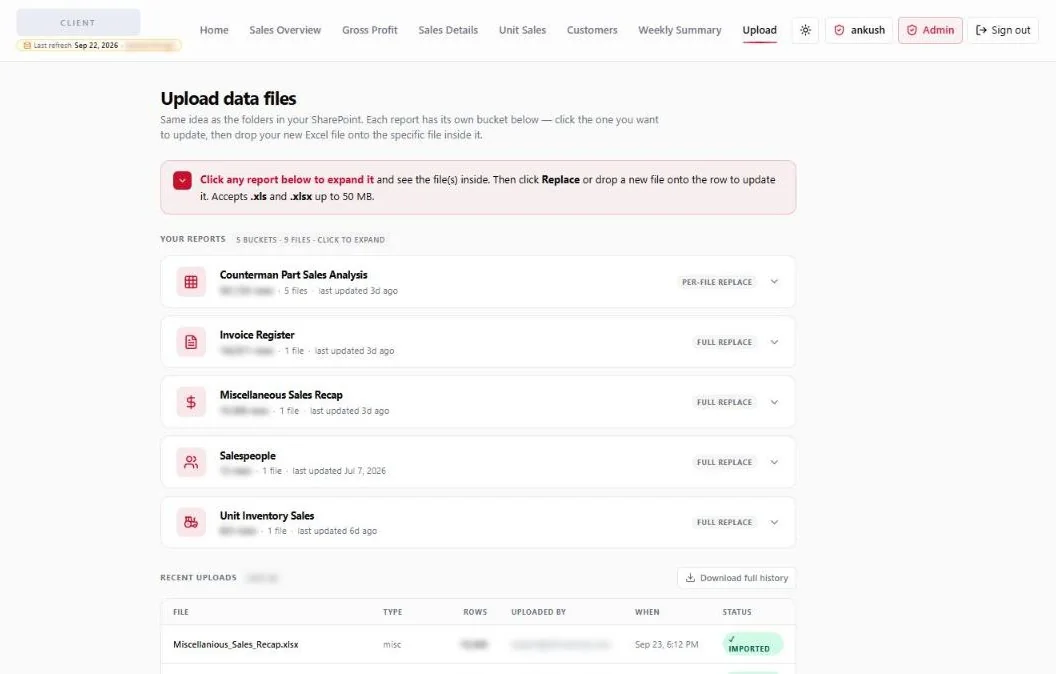
The data modelled properly, the pipeline automated, the whole thing wired to update on its own — and now, mostly, a portal the company owns outright, where their own people upload the data and the dashboards keep themselves current.
It is a worse business model in the short term. It is the only one I would want to buy.
Chapter 05
AI is why I can sell that at a fixed price. Not as a feature on a slide — I mean it closed the gap between what one person can design and what one person can actually finish. Work that used to be a team’s quarter is now a build measured in weeks.
I am clear about what I am. Not a career software engineer — a data and systems person who now ships finished software, because the tooling finally allows it. One of those products is running in production and was never for a client.
A marketing attribution platform that ties ad spend back to the revenue it actually produced, so a marketing team can see which channels pay for themselves rather than which ones look busy. I designed it, built it, and still run it.
It is the reason I will say yes to building software, and not only reporting.
Chapter 06
A company with forty people deserves the same reporting a company with four hundred has, and should not need a data team to get it. That gap is the whole business. The name is the intent — data, devoured. A good system should eat your data problems rather than quietly create new ones.
What follows are commitments rather than opinions, which means you can hold me to them.
Nothing I hand over needs me on a schedule. If a system needs babysitting, it is not finished, and I have not delivered it.
You get the price before the work starts, and it does not move unless you change what you asked for.
You own all of it — the dashboards, the data model, the portal, the code. There is no version of this where leaving me is expensive.
Someone non-technical has to be able to use it without anyone translating for them. If they cannot, it is my problem to fix, not their training issue.
If it is not worth building, I will say so on the call. I have talked people out of projects I could have billed for.
Chapter 07
Datavoris is moving from project work to a product studio: reusable engines and platforms a small team can run with almost no setup. The dashboard portal is the first of those, and the one I care most about — because the measure of it is not a prettier chart. It is that nobody has to wait on me when the numbers change.
If something is breaking — a report that eats a week, numbers nobody trusts, a process held together by copy‑paste — that is the work I want. Tell me what is breaking and I will tell you how I would fix it, or that I would not.
— Ankush Gulati
Founder, Datavoris · Agra, India
Built through years of real client work — not certifications on a wall.
Microsoft Power BI & Fabric · and the rest of the stack
Power BI, AI workflows, Python automation, Zapier — whatever the problem, I've likely built something like it before. Let's talk.