Authenticated portals, internal tools and customer-facing analytics — the applications that do not exist off the shelf and are not worth hiring a permanent engineering team for. The most common one is below: the reporting you already have, moved into a portal your own people keep current.
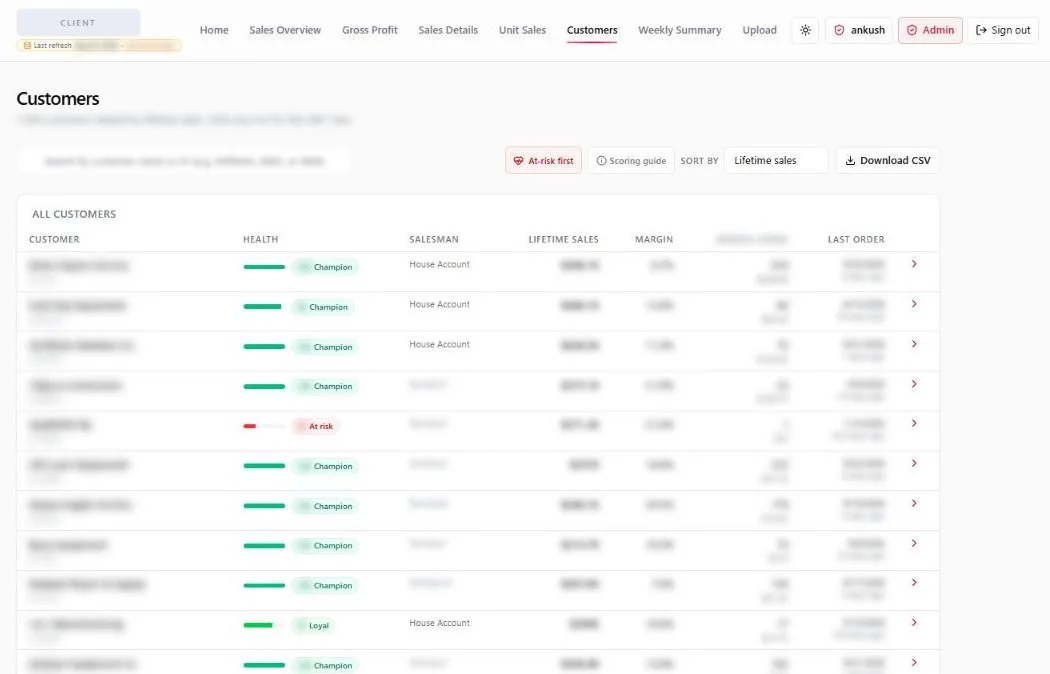
Live client portal · anonymised
Most reporting problems are not really about the chart. They are about how many people have to be in the loop before a number is current.
This is the part that takes us out of your critical path. It is also the part that decides whether a portal actually survives contact with your data.
This is the portal, running. Send one of the sample files and watch the dashboard — including the file that gets rejected and changes nothing.
| File | Uploaded by | Rows | Time | Status |
|---|---|---|---|---|
| orders_week_33.csv | P. Mehra | 4,655 | Mon 08:12 | Loaded — dashboards updated |
| depot_targets_fy26.xlsx | A. Shah | 96 | Mon 07:40 | Loaded — dashboards updated |
Sample data, fictional company
We start from the dashboards you already have.
Everyone who needs the numbers gets in. Nobody sees more than they should.
The part that removes us from your critical path.
The numbers reach people who never log in.
“It updates automatically” is easy to say and hard to do, because real files arrive with a renamed column, a missing week or a total that does not add up. So the portal does not simply accept whatever it is given. Every upload is checked against the rules we agree during the build — required columns, types, date ranges, totals that have to reconcile. A file that passes goes straight through. A file that fails is rejected before it touches a dashboard, and the person who uploaded it is told which rows failed and why, so they can fix it and try again. Nothing silently half-loads, and no dashboard quietly starts showing a wrong number.
Ask us how we would handle your filesPut in your headcount and current BI tool and see the three-year difference between per-seat licences and a flat-cost portal. It runs in your browser and nothing is sent anywhere.
Tell us what you have today, how the data reaches it, and who needs to see it. You get back a migration plan, the upload rules we would agree, and the price — before you commit to anything.